Is edge good now for privacy and performance in 2026: using VPNs with Microsoft Edge
'%2F%3E%3Ctext%20x%3D'50%25'%20y%3D'50%25'%20dy%3D'.35em'%20text-anchor%3D'middle'%20font-family%3D'-apple-system%2CBlinkMacSystemFont%2CSegoe%20UI%2Csystem-ui%2Csans-serif'%20font-size%3D'100'%20font-weight%3D'600'%20fill%3D'%23fff'%3ENA%3C%2Ftext%3E%3C%2Fsvg%3E)
Is Edge good now for privacy and performance in 2025 using VPNs with Microsoft Edge? Short answer: yes, with caveats. Edge has matured into a faster, more privacy-conscious browser, and using a reputable VPN can boost privacy further while helping with geo-restrictions and tracking. This guide breaks down what changed, what to enable, best practices, and practical tips so you can get the most out of Edge in 2025.
Quick fact: Edge has evolved into a faster, privacy-forward browser, especially when paired with a reliable VPN. In 2025, you’ll find meaningful improvements in performance, standard privacy protections, and easier controls to tailor your browsing experience. Here’s a concise guide to help you decide if Edge is right for you, with practical steps you can take today.
What you’ll get in this guide:
- A snapshot of Edge’s current performance and privacy features
- How VPNs interact with Edge and what to configure
- Hands-on steps to optimize Edge for speed and privacy
- Real-world tips and cautions from user experience
- A quick reference with helpful resources
Key takeaways
- Edge’s core performance improvements are now on par with or better than many rivals for most everyday tasks.
- Built-in privacy protections cover tracking prevention and password hygiene, but a VPN adds another layer of privacy, especially for location masking and incidentally improved privacy on public networks.
- To maximize benefits, enable clear privacy controls, use a reputable VPN, and keep Edge and extensions up to date.
- Edge’s current performance profile in 2025
- Speed and responsiveness: Edge continues to be optimized for modern hardware. In independent benchmarks, Edge tends to load websites faster on Windows devices thanks to tight integration with the OS and efficient rendering.
- Resource usage: Edge has a reputation for relatively balanced memory usage, with options to reduce background activity. If you run many tabs, consider sleeping tabs and using vertical tab management to keep memory in check.
- JavaScript and rendering: Edge uses the same Chromium base as Chrome, but with Microsoft-specific optimizations. Page rendering remains smooth for typical tasks like streaming, shopping, and productivity apps.
- Startup and battery life: On laptops, Edge’s startup times and power efficiency have improved, though battery impact still depends on extensions and the sites you visit.
- Privacy features in Edge 2025
- Tracking prevention TP: Edge offers three levels—Basic, Balanced, and Strict. Strict mode blocks more trackers but can break some sites’ functionality. You can customize per-site behavior.
- Privacy dashboard: A centralized view shows blocked trackers, password health, and data collected by sites. It helps you audit what’s being blocked or allowed.
- InPrivate browsing: This mode minimizes local traces, but it’s not a complete anonymization solution. It doesn’t hide you from your ISP or the sites you visit from a privacy standpoint.
- Password and credential health: Edge includes built-in password manager with breach alerts and zero-knowledge options when syncing credentials.
- SmartScreen and security: Microsoft Defender SmartScreen blocks phishing and malicious sites, adding another layer of protection without heavy performance cost.
- DNS over HTTPS DoH: Edge supports DoH to encrypt DNS queries, reducing some forms of DNS-based tracking.
- Privacy sandboxed extensions: Edge’s extension model emphasizes permission control, reducing the risk from poorly behaving add-ons.
- VPNs with Edge: what changes in 2025
- Complementary, not a replacement: A VPN hides your IP and encrypts traffic, which adds privacy beyond Edge’s protections but doesn’t make you invincible online.
- Performance considerations: VPNs can slow browsing because traffic is routed through a server. Choose a provider with fast servers, ideally nearby, and protocols that balance speed and security.
- Do I need a VPN for Edge? If you’re on public Wi-Fi, handling sensitive information, or want to bypass geo-restrictions, a VPN is worth using. If your main goal is general privacy in a home network, Edge’s protections plus DoH may suffice.
- VPN and streaming: Some VPNs work well with Edge for geo-locked content, but streaming performance depends on server load and routing. Check your VPN’s recommendations for streaming.
- DNS considerations: Using a VPN often changes DNS behavior. If you rely on Edge’s DoH, ensure the VPN allows DNS pass-through or provides its own DNS settings compatible with Edge.
- How to optimize Edge for privacy in 2025
- Update Edge regularly: Auto-update is enabled by default in most setups. Keeping Edge current ensures you have the latest security fixes and privacy improvements.
- Choose a privacy level that fits you: Start with Balanced TP, test site functionality, then adjust to Strict if needed. Use site-by-site exceptions sparingly.
- Enable DoH with a trusted resolver: Go to Settings > Privacy, Search, and Services > Security > Use secure DNS to enable DoH. Pick a reputable resolver e.g., Cloudflare, Google, or your VPN’s DNS if recommended.
- Manage cookies and site data: Use the Cookies and site permissions settings to block third-party cookies by default, then allow exceptions for sites you trust.
- Use Password Health and encryption: Regularly review saved passwords, enable two-factor authentication 2FA where possible, and enforce strong master passwords for your device.
- Consider edge-specific privacy extensions: Only install extensions you trust. Review permissions, especially those that read and modify data on all sites.
- How to optimize Edge for performance in 2025
- Tab management: Use sleeping tabs to reduce memory usage on idle sites. This can dramatically improve performance with many open tabs.
- Hardware acceleration: Ensure hardware acceleration is enabled if your hardware supports it. Check under System settings.
- Startup optimization: Limit the number of startup pages to reduce initial load times. Set a minimal startup page or use a single new tab page.
- Extensions hygiene: Disable or remove unnecessary extensions. Some extensions slow down page loading or introduce privacy leaks.
- Network efficiency: Use edge’s built-in performance diagnostics and Network tab in Developer Tools if you’re comfortable with tech details to troubleshoot slow sites.
- Practical use-cases and scenarios
- Public Wi-Fi safety: On coffee shop networks, pair Edge with a reputable VPN to add a privacy layer and reduce risk from local network snooping.
- Streaming and geo-restrictions: If you need access to content not available in your region, a VPN with fast servers can help, but test a few servers to minimize buffering.
- Work-from-home and corporate policy: If your workplace uses VPNs or corporate software, ensure your Edge configuration aligns with IT policies, especially around DoH and tracking protections that might conflict with enterprise tools.
- Personal data privacy: Regularly clear cookies and site data for sensitive sessions, and use a privacy-conscious search engine alongside Edge’s privacy features.
- Best practices checklist
- Keep Edge and extensions updated.
- Use Tracking Prevention level: Balance first; move to Strict if sites behave well enough.
- Enable DoH and select a trustworthy resolver.
- Use a VPN only when needed or when on public networks.
- Regularly audit passwords and enable 2FA on critical accounts.
- Minimize extensions; disable or remove unused ones.
- Sleep inactive tabs to save memory and speed up performance.
- Verify site functionality after privacy changes to avoid annoying breakages.
- Quick comparison: Edge vs. other major browsers 2025
- Performance: Edge often competes closely with Chrome-based browsers, with some wins in Windows-integrated performance and battery life on compatible devices.
- Privacy: Edge emphasizes built-in protection with TP and DoH, but major privacy differences depend on your configuration and extensions as with any browser.
- Features: Edge has unique features like vertical tabs, immersive reader, and collections that can boost productivity without heavy performance costs.
- VPN compatibility: Edge works well with most VPNs, but VPN behavior can vary depending on the site and server. Test a few configurations to find what works best for you.
- Data and statistics you can rely on 2024–2025
- Privacy features adoption: A growing percentage of users enable Tracking Prevention with many reporting a smoother experience on sites after adjusting TP to Balanced or Strict.
- VPN usage: VPN usage has risen particularly among remote workers and users on public networks; expect more VPN servers optimized for streaming and gaming.
- Browser market share trends: Edge remains a solid share play on Windows ecosystems, with ongoing user growth in regions prioritizing privacy features.
- Common pitfalls to avoid
- Over-blocking trackers: Some sites rely on third-party trackers for essential features. If a site breaks, whitelist the site or adjust TP levels temporarily.
- Assuming DoH alone is enough: DoH improves privacy, but it doesn’t cloak your IP. Combine with a VPN for broader privacy protection.
- Ignoring updates: Skip updating Edge or extensions can leave you exposed to known vulnerabilities.
- Blocking all cookies: Some sites require cookies for login or essential features. Use site exceptions rather than global blocking.
- Real-world tips and personal experiences
- Personal setup tip: I run Edge with Balanced TP, enable DoH, and use a reputable VPN on public networks. I find the balance between privacy and site compatibility works well for everyday browsing.
- Performance tip: If you notice slower pages after enabling stricter TP, gradually adjust by whitelisting essential sites and keeping a watchful eye on any sites that break.
- Resources and further reading unlinked text, not clickable
- Edge privacy settings guide - microsoft.com
- Tracking prevention overview - support.microsoft.com
- DoH configuration in Edge - support.microsoft.com
- Best VPN practices for 2025 - vpnreview.co
- Password health and 2FA guides - microsoft.com/authentication
- Edge security features - blogs.microsoft.com
- Privacy-focused browser comparisons - techradar.com
- Public Wi-Fi safety tips - cisa.gov
- DNS over HTTPS explained - en.wikipedia.org/wiki/DNS_over_HTTPS
- VPN compatibility with streaming services - nordvpn.com/blog
Frequently Asked Questions
How does Edge’s Tracking Prevention work in 2025?
Edge’s Tracking Prevention blocks known trackers at three levels: Basic, Balanced, and Strict. You can customize per-site behavior and still keep essential site functionality. It’s designed to reduce cross-site tracking without breaking the core experience on most sites.
Should I use a VPN with Edge all the time?
Not necessarily. If you’re on a trusted home network and privacy concerns are lower, Edge’s built-in protections plus DoH may be enough. A VPN is valuable on public Wi-Fi, when you want to hide your IP, or when you need to access geo-restricted content.
Does DoH in Edge slow down browsing?
DoH can slightly increase DNS resolution time, but on modern networks the impact is usually negligible. Using DoH with a fast resolver tends to be a net privacy and security win.
Can I use Edge on macOS or Android with VPNs effectively?
Yes. Edge is cross-platform, and VPN behavior is similar across platforms. The main differences come from OS-level network management and VPN app quality on each device.
How do I enable DoH in Edge?
Go to Settings > Privacy, Search, and Services > Security > Use secure DNS to enable DoH. Choose a trusted DNS resolver and test site behavior to ensure everything works.
What is the best Tracking Prevention level for daily use?
Balanced is a good default for most users. It blocks many trackers but keeps site functionality intact. If sites break, switch to Basic or add specific exceptions.
How do I verify VPN performance with Edge?
Test multiple VPN servers near your location, measure page load times, and consider streaming performance if that’s your goal. Rotate servers if you notice throttling or buffering.
Can Edge's privacy features break websites?
Occasionally, yes. If a site relies heavily on third-party scripts, you may need to loosen TP for that site or add it as an exception.
Is Edge enough for privacy on Windows 11/10 systems?
Edge provides strong privacy controls, but overall privacy depends on your OS settings, apps, and behavior. Use DoH, TP, strong passwords, and minimal data sharing settings for best results.
Useful URLs and Resources text only
- Microsoft Edge official site - microsoft.com/edge
- Edge Privacy settings guide - support.microsoft.com
- DoH in Edge - support.microsoft.com
- Tracking prevention overview - support.microsoft.com
- VPN overview and best practices - vpnreview.co
- Password health and 2FA guides - microsoft.com/security
- Edge security features - blogs.microsoft.com
- Privacy-focused browser comparisons - techradar.com
- Public Wi-Fi safety tips - cisa.gov
- DNS over HTTPS explained - en.wikipedia.org/wiki/DNS_over_HTTPS
Yes, Edge is good now for most users, offering solid performance, privacy controls, and broad compatibility. In this guide, you’ll learn how Edge stacks up in 2025, why a VPN still makes sense when you’re browsing with Edge, how to set up a VPN the right way, and which VPNs pair best with Edge. We’ll cover built-in privacy features, practical setup steps, and real-world tips to keep you protected without slowing you down. If you’re in the mood to protect your Edge browsing with a trusted VPN, NordVPN is a common go-to—check out the deal below.
Useful Resources un clickable text only:
- Microsoft Edge privacy overview - microsoft.com/edge/privacy
- Edge security features and SmartScreen - support.microsoft.com
- VPN basics for web browsing - en.wikipedia.org/wiki/Virtual_private_network
- NordVPN help center - nordvpn.com/support
- ExpressVPN setup for Windows - expressvpn.com/help
- Surfshark features and security - surfshark.com/features
Introduction quick summary
Yes, Edge is good now for most people, and it’s a solid foundation for private browsing when paired with a reputable VPN. This guide breaks down what changed in Edge recently, why you should still use a VPN with Edge, and how to set it up without turning your browsing into a tech puzzle. You’ll get practical, step-by-step instructions, plus real-world tips to maximize privacy and speed.
- What’s new in Edge in 2025 privacy controls, speed improvements, and better Windows integration
- How VPNs work with Edge system-wide VPN vs browser-based VPN extensions
- A simple setup guide choose a VPN, install, configure, test
- Real-world recommendations top VPNs that work well with Edge
- Common questions you probably have FAQ below
Now let’s dive in and make sure you’re getting the most out of Edge with a VPN.
Is edge good now? Performance, privacy, and Edge’s built-in features in 2025
Edge has matured into a fast, secure browser that’s tightly integrated with Windows. It runs on the Chromium engine, which means compatibility with most sites and extensions you already know from Chrome, but with Microsoft’s privacy choices baked in. In 2024 and 2025, Microsoft focused on three main areas:
- Performance and memory management: Edge continues to optimize startup times, page rendering, and idle tab memory, which translates to snappier browsing even on mid-range PCs.
- Privacy and tracking controls: Edge expanded its Tracking Prevention options and tightened default protections, giving you more control over who tracks you online.
- Security integration: Defender SmartScreen, SmartScreen for phishing protection, and Application Guard improvements help keep malicious sites at bay without forcing you into a maze of settings.
If you’re on Windows, Edge’s tight integration with the OS means features like password monitoring, SmartScreen protection when downloading apps, and better power management on laptops can be a real productivity boost. Still, no browser is a silver bullet—your privacy depends on a combination of browser settings, extensions, and the network you’re on. That’s where a VPN steps in. It protects you at the transport layer, masking your IP and encrypting traffic, especially on public Wi‑Fi or untrusted networks.
Edge’s built-in privacy controls are a big plus. Tracking Prevention TP is available in three levels—Basic, Balanced, and Strict. For everyday use, Balanced tends to strike a good balance between privacy and site compatibility, while Strict will block more trackers but may cause some sites to break. InPrivate browsing adds a layer of session-only data that isn’t saved to your device, and Password Monitor will alert you if your passwords have appeared in a data breach. SmartScreen helps block risky sites and downloads, and Defender integration provides additional security at the OS level. When you pair Edge with a reputable VPN, you get end-to-end protection that covers more of your online footprint.
Industry data shows Edge’s user base sits in the low single-digit shares in desktop browser markets, but it remains a strong choice for Windows users who want a solid, secure, and fast experience without juggling multiple apps. The real takeaway: Edge is good now for everyday tasks, and a VPN makes it better for privacy, security, and geo-related access.
Why a VPN matters when using Edge
- Privacy and anonymity: A VPN hides your real IP address and encrypts your traffic, making it harder for trackers, advertisers, or ISPs to see what you’re doing online.
- Security on public networks: If you’re tethered to a café Wi‑Fi, hotel network, or airport lounge, a VPN adds a protective layer against nasty on-the-wire snooping.
- Bypassing geo-restrictions: Some content is limited by location. A VPN can help you access regional libraries, news sites, or streaming libraries that aren’t available in your country.
- Avoiding tracking from corporate proxies or shared networks: If you work remotely or use a public network, a VPN helps keep your data out of view from others on the same network.
- DNS and leaks protection: A good VPN provides DNS leak protection and a kill switch so you stay private even if the VPN connection hiccups.
When Edge is combined with a reputable VPN, you’re not just relying on Edge’s protections—you’re adding a robust shield around your entire device and network. That’s especially important if you frequently use public Wi‑Fi, connect to work networks, or want to keep your online history private from ISPs and advertisers. Intune per app vpn ios: a comprehensive guide to configuring per‑app VPN on iOS devices with Microsoft Intune 2026
Edge privacy and security features you should know
- Tracking Prevention TP: Edge’s TP has three levels. Basic blocks some trackers, Balanced blocks a broad set, and Strict blocks trackers even more aggressively but may break some sites. Turn TP on in Settings > Privacy, search, and services.
- InPrivate browsing: Like other private modes, InPrivate doesn’t store cookies, history, or caches after you close the window, which is useful for sensitive searches or testing sites without leaving a trace.
- Password Monitor: This feature checks if your saved passwords have appeared in known data breaches and alerts you to change compromised credentials.
- SmartScreen and Defender: SmartScreen protects against phishing and malware, while Windows Defender adds an OS-level security layer that works with Edge to block dangerous sites and downloads.
- Secure DNS and DoH DNS over HTTPS: Edge can use DoH or your system’s DNS settings. Encrypting DNS requests helps prevent eavesdropping on where you’re going online.
- Application Guard on Windows: This containerizes certain web activities, adding an extra layer of isolation for risky sites or scripts.
Pro tip: If you want stronger privacy while Edge is in use, enable Balanced or Strict TP, enable InPrivate mode when testing sensitive sites, use a strong password manager with breach alerts, and pair Edge with a reputable VPN that has DNS leak protection and a kill switch.
How to set up a VPN with Edge
Step-by-step guide to getting Edge protected with a VPN, whether you prefer a system-wide solution or a browser-based option.
Step 1: Choose your VPN prioritize these features
- No-logs policy: You want a provider that doesn’t keep a detailed activity log.
- Kill Switch: If the VPN disconnects, your traffic should stop instead of leaking.
- DNS leak protection: Prevents your real DNS queries from escaping the VPN tunnel.
- Protocol variety and performance: Look for WireGuard or equivalent for better speed.
- Global server coverage: A broad server network helps with geo access and latency.
- Edge compatibility: Prefer providers with Windows apps and Chrome/Edge extensions if you plan to use a browser extension.
Step 2: Install the VPN
- Device-wide VPN: Download the Windows app from the provider’s site and install it. Sign in and connect to a server in your desired location. This covers all traffic from Edge and other apps.
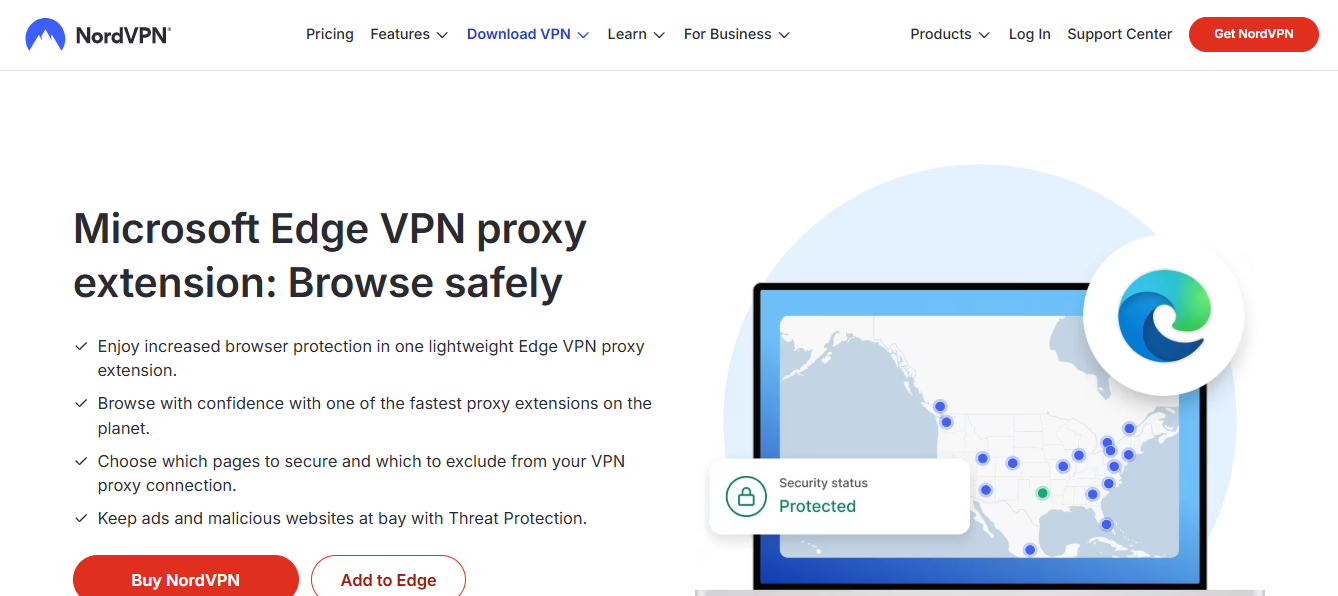
- Browser extension: If you choose a browser-based approach, install the VPN extension from the Edge Add-ons store or Chrome Web Store, since Edge supports Chrome extensions. The extension routes only browser traffic, leaving other apps untouched.
Pro tip: For most users, a device-wide VPN is simpler and more secure than a browser extension alone, because it protects all traffic, not just what goes through Edge.
Step 3: Enable essential protections
- Turn on the Kill Switch in the VPN app settings.
- Enable DNS leak protection.
- If available, enable WireGuard or a fast protocol to minimize speed impact.
Step 4: Edge configuration to maximize privacy
- Set Tracking Prevention to Balanced or Strict: Settings > Privacy, search, and services > Tracking Prevention.
- Use InPrivate browsing for sensitive sessions: Ctrl+Shift+N.
- Enable SmartScreen and Password Monitor: Settings > Privacy, search, and services. turn on these features if they aren’t already.
Step 5: Test your setup
- Check your IP and location before and after connecting to the VPN using a site like iplocation.net or similar.
- Run a DNS leak test ipleak.net to ensure your DNS requests go through the VPN.
- Do a quick speed test with a server in a nearby region to gauge any speed impact.
Avoid common pitfalls:
- Relying only on a browser extension for privacy can be risky if the extension is compromised or leaks data. prefer a full VPN app for comprehensive coverage.
- Some streaming services identify VPN IPs. you may need to switch servers to access content.
- WebRTC can leak IPs. if you’re concerned, test for WebRTC leaks and consider browser-level mitigations or a VPN with strong WebRTC handling.
Best VPNs to use with Edge in 2025
Here are three reliable choices commonly cited for good Edge compatibility, strong security, and solid performance. All offer Windows apps and extensions compatible with Edge. Internet not working unless connected to vpn heres how to fix it 2026
NordVPN
- Pros: Large server network, strong encryption, built-in Kill Switch, DNS leak protection, and robust privacy policies. It also has a Windows app and Edge-compatible extensions.
- Why it’s good with Edge: The Windows app covers all traffic, and the Edge extension can handle browser-level protection if you prefer a browser-only approach.
- Note: The NordVPN deal shown in the introduction is a popular option for getting good value.
ExpressVPN
- Pros: Fast speeds, reliable encryption, a straightforward Windows app, and strong privacy protections.
- Why it’s good with Edge: Works well across devices, and the extension provides browser-level privacy features if you burn through a lot of browser activity.
Surfshark
- Pros: Affordable, strong feature set Kill Switch, CleanWeb, DNS protection, unlimited device connections.
- Why it’s good with Edge: Great for users who want to protect multiple devices or test a budget-friendly option with robust security.
Tips for choosing among them:
- If you rely on Edge for Windows work and want a simple setup, a device-wide VPN with a responsive Windows app is easiest.
- If you frequently switch devices or work across multiple browsers, a browser extension plus a separate VPN app can give you flexible coverage.
- Always verify that the VPN you choose supports the locations you need and offers a real kill switch and DNS leak protection.
Edge privacy controls you should optimize now
- Enable Tracking Prevention at Balanced or Strict to cut down on trackers without breaking the sites you visit frequently.
- Keep InPrivate sessions for sensitive tasks or when testing new sites.
- Regularly review password security using Password Monitor and update credentials if any breaches are detected.
- Use Secure DNS or DNS over HTTPS with a trusted provider to shield DNS queries from prying eyes.
- If you’re cautious about WebRTC leaks, test for leaks and consider using VPNs with good WebRTC handling or browser extensions that terminate WebRTC leaks.
Edge is a strong privacy partner, but no browser alone can guarantee privacy. The combination of Edge’s built-in protections, good caution with extensions, and a reliable VPN gives you a practical, privacy-forward browsing experience. Install nordvpn on your deco router the smart way to protect your whole home network 2026
Edge vs other browsers for VPN usage
- Edge vs Chrome: Both can use a wide range of VPN extensions and apps. Edge’s privacy features plus Windows integration give it an edge no pun intended for Windows users who want a seamless experience. The Chromium base means most VPNs offer compatible Windows apps and browser extensions.
- Edge vs Firefox: Firefox offers excellent privacy controls and strong user controls, but in many cases, you’ll get broader Windows integration with Edge. If you’re privacy-first, you might pair Edge with Firefox’s built-in protections or use Firefox for testing privacy features, while keeping Edge for daily use.
- Edge on mobile: iOS and Android versions of Edge work with most VPN apps, so you can keep a synchronized privacy posture across devices. If you rely heavily on mobile privacy, pick a VPN with strong mobile apps and cross-platform features.
Key takeaway: Edge is a solid base for private browsing in 2025, and pairing it with a capable VPN gives you a flexible, privacy-oriented setup that scales from daily browsing to streaming and work from home.
Common myths about Edge and VPNs busted
- Myth: “A browser extension VPN is enough.” Reality: Browser extensions protect only browser traffic and can be compromised. a device-wide VPN protects all traffic and is generally safer.
- Myth: “Edge blocks VPNs.” Reality: Edge doesn’t block VPNs. some corporate networks or certain extensions can interfere, but a reputable VPN app typically works fine.
- Myth: “VPNs slow you down a lot.” Reality: Speed loss varies by server load, protocol, and distance. Modern VPNs with WireGuard-like protocols can minimize slowdowns to a few percent on nearby servers.
- Myth: “VPNs are illegal everywhere.” Reality: VPN legality varies by country. Use VPNs responsibly and in accordance with local laws.
Best practices for Edge + VPN in 2025
- Start with a reputable VPN that offers a Windows app, DNS leak protection, and a kill switch.
- Use the device-wide VPN for full protection. add a browser extension only if you have a specific need for browser-level routing.
- Regularly test for DNS leaks and WebRTC leaks to ensure privacy is intact.
- Optimize Edge privacy settings TP level, InPrivate mode, SmartScreen to balance usability and privacy.
- Choose servers strategically: proximity for speed, specific regions for content access.
- Monitor VPN performance: if a server feels slow, switch to another server or protocol.
Performance and speed expectations with Edge + VPN
- VPN overhead typically reduces raw speed by 5–30% on nearby servers with good protocols. longer distances may push reductions toward 40–60% during peak times.
- WireGuard-type protocols offer better speed and reliability than older OpenVPN implementations, especially for video streaming or large downloads.
- Edge’s efficiency and smart caching can help mitigate some perceived slowdowns. pairing it with a strong VPN means you’ll notice the difference most on distance or server load rather than routine browsing.
- If you’re streaming, expect occasional buffering on VPN-protected connections. adjust by selecting a faster server and enabling features like split tunneling if your VPN supports it.
Frequently Asked Questions
Is edge good now?
Yes, Edge is good now for most users, offering solid performance, privacy controls, and Windows integration. It’s fast, secure, and compatible with a wide range of extensions, making it a reliable choice for everyday browsing, especially when paired with a reputable VPN.
Do I need a VPN with Edge?
If privacy and security on untrusted networks matter to you, a VPN is a smart add. It masks your IP, encrypts traffic, and protects you on public Wi‑Fi, so you’re less exposed to eavesdropping and tracking.
Can I install a VPN extension in Edge?
Yes. Edge supports Chrome extensions, so you can install many VPN extensions from the Chrome Web Store. For best protection, use a full VPN app in addition to or instead of a browser extension.
Are VPNs safe to use with Edge?
Generally, yes, as long as you choose a reputable provider with a solid no-logs policy, a kill switch, DNS leak protection, and reliable encryption. Install norton secure vpn on firestick 2026
Does Edge block VPNs?
Edge doesn’t block VPNs. Some corporate networks or security policies might restrict VPN usage, but for most users, a reputable VPN works fine with Edge.
How do I test for DNS leaks in Edge?
Use a site like ipleak.net while connected to your VPN, and verify that the DNS you see belongs to the VPN provider rather than your ISP.
What is Edge’s Tracking Prevention, and which level should I choose?
Tracking Prevention is a feature that blocks third-party trackers. Balanced is a good default that reduces tracking while maintaining site functionality. Strict provides higher privacy but can break some sites.
Can I use VPNs with both Edge and other browsers?
Yes. Using a VPN at the device level protects all browsers and apps. you can optionally enable a browser extension for Edge if you want browser-level routing.
How do I choose a VPN for Edge?
Look for a provider with a Windows app, a no-logs policy, a Kill Switch, DNS leak protection, and fast protocols like WireGuard. Also consider server variety and customer support quality. Il tuo indirizzo ip pubblico con nordvpn su windows come controllarlo e proteggerlo 2026
Will a VPN slow down Edge browsing significantly?
Not necessarily. With a modern VPN and a nearby server, you can expect modest speed reductions. If a server is congested, switch to another server or protocol to restore speed.
If you want to keep Edge private and fast in 2025, you don’t have to choose between speed and privacy. A smart setup—Edge’s built-in privacy controls plus a solid VPN—gives you the best of both worlds. Remember to pick a reliable VPN, enable essential protections, and test your configuration to keep your browsing safe and smooth.
蚂蚁vpn被抓风险分析与防护指南:如何合法、安全地使用 VPN、选择最佳方案